
12 Unexpected Tank Mates That Thrive with Guppies (Beyond Corys)
May 2, 2025 Guppy Fish Uncategorized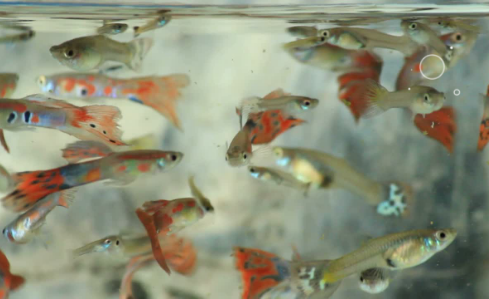
🤩 12 Unexpected Tank Mates That Thrive with Guppies (Beyond Corys)
Guppies are the quintessential community fish—colorful, active, and peaceful.1 When choosing tank mates, the key is finding fish that share the guppy’s preference for warm, slightly harder water, won’t nip at their elaborate fins, and won’t eat their fry (or at least, won’t eat the adult guppies!).
While everyone recommends Corydoras, Platies, and Neon Tetras, let’s explore 12 fascinating and sometimes overlooked species that will bring unique life and color to your guppy tank without any conflict.
Mid-Water & Upper Column Dwellers (The Flashy Neighbors)
These fish occupy the same middle and upper layers as guppies but are fast, peaceful, and provide visual contrast.
1. Celestial Pearl Danio (CPD) – Danio margaritatus2
- Why they work: The CPD is a tiny, stunningly beautiful nano fish. They are not as frantic as Zebra Danios and their small size ($0.75$ inches) and peaceful demeanor pose zero threat to guppies. They prefer the upper and middle water column, often darting through plants.
- Tank Tip: Keep them in groups of $6$ or more for the best behavior and color.
2. Dwarf Neon Rainbowfish – Melanotaenia praecox3
- Why they work: Unlike larger Rainbowfish, the Dwarf Neon variety only reaches about $2$ inches. They are active, peaceful, and their shimmering blue scales and red fins provide a fantastic color break from the guppies’ patterns. They tend to stay in the middle to upper water levels.
- Tank Tip: Ensure your tank is $20$ gallons or larger, as they need space to school and swim.
3. Harlequin Rasbora – Trigonostigma heteromorpha
- Why they work: A staple in planted tanks, Harlequins are extremely hardy and peaceful. Their unique black ‘pork chop’ marking and rich copper body color contrast beautifully with the bright, multi-chroma guppies. They are active mid-water schoolers.
- Tank Tip: They are slightly tolerant of higher $\text{pH}$ and $\text{GH}$ that guppies love, making them an ideal match.
4. Sparkling Gourami – Trichopsis pumila
- Why they work: For a beautiful centerpiece that won’t harass fins, the Sparkling Gourami is a great alternative to the often-nippy Dwarf Gourami.4 They are tiny ($1.5$ inches), peaceful, and make a quiet, crackling sound (hence, “sparkling”) that is fascinating to listen for.
- Tank Tip: They need plenty of dense planting and floating cover to feel secure.5
Bottom Dwellers & Scavengers (The Clean-Up Crew Alternatives)
Forget the common Cory, these bottom dwellers are far more unique and serve an excellent function in the tank.
5. Otocinclus Catfish (Otos) – Otocinclus spp.6
- Why they work: These are the ultimate specialized algae eaters for a guppy tank, growing only to about $1.5$ to $2$ inches. Unlike the Bristlenose Pleco (which can get large), Otos stay tiny and are incredibly peaceful, clinging to leaves, glass, and decor.
- Tank Tip: They require a mature, cycled tank with established algae/biofilm and must be kept in a school of at least $6$ for security.
6. Kuhli Loach – Pangio kuhlii7
- Why they work: These thin, eel-like loaches are non-aggressive, nocturnal scavengers with striking banded patterns. They spend their time burrowing in soft substrate (sand is best!) and consuming uneaten food, keeping the substrate aerated. They are harmless to guppies and fry.
- Tank Tip: They must be kept in groups of $5$ or more. Don’t worry if you don’t see them during the day; they come out at night.
7. Dwarf Anchor Catfish – Hara jerdoni
- Why they work: This is a truly unexpected tank mate. These small, spiky catfish ($1.5$ inches) are shy, peaceful, and stay cemented to the substrate or driftwood. They are a unique, tiny bottom-layer addition that won’t move much, providing excellent contrast to the darting guppies.
- Tank Tip: They are rare but worth the search, as they demand a mature tank with minimal water flow.
8. Mystery Snails – Pomacea bridgesii
- Why they work: While a snail might not be “unexpected,” the sheer variety of colors (purple, blue, gold, ivory) they offer is a vibrant alternative to adding more fish color. They are fantastic detritus and algae cleaners, cannot eat healthy live plants, and are large enough not to be harassed by guppies.
- Tank Tip: Guppies thrive in hard water, which is perfect for supporting the snail’s shell growth. Supplement with calcium if needed.
The Invertebrate & “Oddball” Cleaners
These species bring an entirely different form and function to the guppy community.
9. Amano Shrimp – Caridina multidentata8
- Why they work: Amano Shrimp are the heavy-duty workers of the shrimp world. They are larger than the more delicate Cherry Shrimp (about $2$ inches), making them less likely to be eaten by adult guppies. They are voracious algae eaters, tackling types of algae fish won’t touch.
- Tank Tip: They are more sensitive to water changes than guppies, so ensure your weekly water change routine is slow and steady.
10. African Dwarf Frogs (ADFs) – Hymenochirus boettgeri
- Why they work: ADFs are peaceful, fully aquatic amphibians that occupy the bottom of the tank, completely ignoring mid-water fish like guppies. They provide a fun, non-fish element to your aquarium.
- Tank Tip: They are slow eaters and need their own sinking pellets or tongs-fed food to ensure they get enough to eat before the guppies steal it all. Ensure a secure lid, as they can occasionally jump.
11. Endler’s Livebearers – Poecilia wingei9
- Why they work: Okay, so they are relatives, but keeping pure male Endler’s (if your guppies are all male) or a separate colony offers a stunning, smaller contrast. They are arguably more vigorous and colorful than guppies, yet share the exact same water needs.
- Tank Tip: Warning: They will readily hybridize with guppies, so only mix sexes if you plan to keep the resulting hybrid fry.
12. Chili Rasbora – Boraras brigittae10
- Why they work: As one of the smallest fish in the hobby ($0.5$ to $0.75$ inches), the Chili Rasbora provides an intense pop of red color without adding significant bioload. They are shy but incredibly peaceful and will hover near plants, creating a stunning micro-schooling effect beneath the main guppy activity.
- Tank Tip: While they prefer slightly softer water than guppies, they are adaptable enough to thrive in the warm, hard water guppies prefer, provided it’s pristine.