
What is the Guppy’s Gonopodium? A Detailed Male Anatomy Explainer
February 15, 2024 Cichlids Fish Discus Fish🐠 Introduction: Understanding the Guppy’s Unique Anatomy
Among livebearer fish, male guppies stand out not just for their brilliant colors and flowing tails but also for a specialized reproductive organ called the gonopodium. This unique fin structure is a modified part of the anal fin that plays a vital role in mating.
For breeders and hobbyists, understanding how the gonopodium functions helps identify males accurately, monitor breeding health, and even prevent accidental crossbreeding. Let’s dive deeper into this fascinating aspect of guppy anatomy.
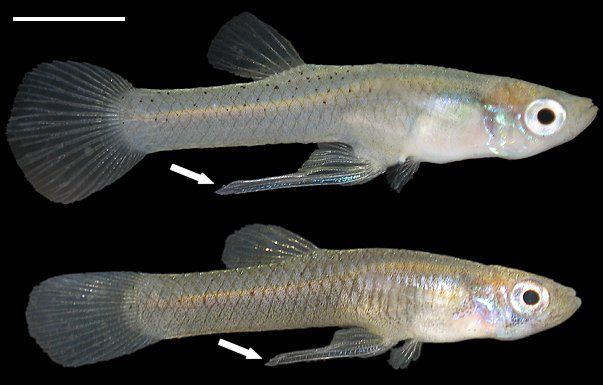
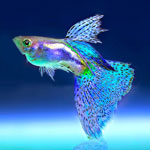
Alt Text: Close-up of a male guppy highlighting the elongated gonopodium used in reproduction.*
🔬 What is the Gonopodium?
The gonopodium is a modified anal fin found only in male livebearers, including guppies (Poecilia reticulata), mollies, platies, and swordtails. Instead of functioning like a regular fin, it has evolved into a reproductive organ that transfers sperm to the female during mating.
It’s a slender, tube-like structure composed of rays 3, 4, and 5 of the anal fin, fused and elongated to form a precise, flexible instrument for fertilization.
⚙️ Function: The Role of the Gonopodium in Reproduction
During mating, the male guppy approaches the female from behind and uses the gonopodium to insert sperm packets (spermatophores) into the female’s genital pore. This internal fertilization process allows females to store sperm for months, enabling multiple pregnancies from a single mating.
This unique reproductive strategy contributes to the guppy’s rapid population growth and adaptability in the wild and in captivity.

Alt Text: Male guppy using its gonopodium to initiate mating behavior with a female guppy.*
🧬 Anatomy Breakdown: Key Features of the Gonopodium
| Part | Description | Function |
|---|---|---|
| Base | Root area connected to the anal fin rays | Provides movement and flexibility |
| Tip (Gonopodial Spine) | Narrow, pointed end | Aids in directing sperm packets |
| Hooks/Spines | Minute extensions on tip | Help secure contact during mating |
| Sheath | Protective membrane | Keeps the organ streamlined when not in use |
The gonopodium can move independently, controlled by specialized muscles that help males aim precisely during copulation — a key adaptation for livebearing species.
📈 Sexual Dimorphism: Identifying Males and Females
In juvenile guppies, the gonopodium starts forming around 3–4 weeks of age. By adulthood, it’s easy to tell the difference:
-
Males: Slim body, colorful fins, elongated gonopodium.
-
Females: Larger body, gravid spot near the abdomen, rounded anal fin.
This clear difference is crucial for selective breeding and maintaining balanced aquarium populations.
Alt Text: Comparison showing elongated gonopodium in male guppy versus rounded anal fin in female.*
⚠️ Common Health Issues with the Gonopodium
Even though the gonopodium is a hardy structure, males can suffer from issues due to poor water quality or aggression:
-
Fin Damage: Torn or bent gonopodiums caused by fin nipping or collisions.
-
Infection: Fungal or bacterial buildup at the fin base due to dirty water.
-
Deformities: Genetic issues or inbreeding can cause malformed gonopodia, leading to breeding difficulty.
Prevention Tips:
-
Maintain clean water with weekly testing.
-
Keep tank mates peaceful.
-
Avoid overbreeding and select only healthy males for breeding programs.
🧠 Fun Fact: Guppies Use the Gonopodium with Precision
Male guppies can move their gonopodium 180 degrees forward or sideways, allowing them to quickly fertilize females even in fast-moving schools. Some researchers refer to it as one of the most adaptively evolved organs in freshwater fish anatomy.