
The Future of Livebearers: My Predictions on Guppy Color Trends
September 21, 2024 Guppy Fish
👑 The Horizon of the Hobby: My 1500-Word Deep Dive into Guppy Color Trends
The Perpetual Evolution of Poecilia reticulata
The guppy, Poecilia reticulata, has been at the forefront of the aquarium hobby for over a century. Yet, unlike many stable ornamental species, the guppy is in a state of perpetual, rapid evolution, driven entirely by dedicated selective breeding. Every show season brings new, unprecedented colors and finnage. We have moved lightyears beyond the basic wild-type guppy, advancing through two distinct breeding eras:
- The Fin-First Era (1950s – 1980s): Focused primarily on fin size and shape (e.g., Delta tails, Lyretails).
- The Color-Density Era (1990s – 2010s): Focused on maximizing a single, solid color or pattern coverage (e.g., solid Red Dragon, full-coverage Snakeskin).
We are now entering a third, highly sophisticated era: The Era of Complexity and Texture. This phase demands not just beautiful color, but genetic mastery over how that color is expressed—its depth, its texture, and its relationship with other hues.
Based on current global breeding trends and the available genetic markers, here are my three core predictions for the guppy colors and patterns that will dominate the show tanks and enthusiast markets in the coming five to ten years.
Prediction 1: Chromatic Complexity – The Triple-Pigment Fusion
The ultimate prize is a guppy that utilizes the three main chromatophores (pigment cells)—Xanthophores (yellow/orange), Erythrophores (red), and Iridophores (metallic/reflective)—in a clearly defined, non-bleeding, multi-color display.
A. The True Tri-Color Guppy
We already see ‘Koi’ guppies, but they often rely on the absence of color (white) or the spread of color. The future is a strain that clearly displays three vibrant colors simultaneously in three distinct, predictable areas.
- The Trend: The Neon Spectrum Strain. This guppy will feature a head/pectoral area in a pure metallic blue, a mid-body patch of intense, non-fading red, and a caudal fin featuring a luminous yellow/orange. The boundaries between these three regions will be sharp, not blended.
- The Technical Challenge: This requires breeders to suppress the natural tendency of these pigments to spread and overlap. Specifically, controlling the Blue-IR-1 and Red-IR-2 genetic loci to allow for defined areas of color separation, a level of control that rivals the selective breeding seen in Japanese Koi fish. Achieving this three-color saturation without the appearance of ‘dirty’ or mottled grey areas is the major hurdle, and the first breeder to stabilize this will set the market standard.
B. The Black & White Dichotomy (The Monochrome Phantom)
High contrast is paramount in judging. The future of contrast will lean into the elegant extremes of black and white.
- The Trend: Matte Black & Snow White Splits. Existing strains like Panda or Tuxedo often feature grayish-black or translucent fins. The next generation will have velvety, matte, light-absorbing black (the maximum expression of Melanophores) contrasting sharply with chromatophore-free, stark snow white.
- Application: Look for strains where the front half of the body is pure white and the back half, including the fins, is solid, deep matte black. Alternatively, a perfect white dorsal fin over a black body, maximizing the visual pop under competition lighting. This demands a selective culling process that eliminates any fish showing ‘salt-and-pepper’ or mottled gray pigmentation.
Prediction 2: Texture & Depth – The Non-Reflective Finish
In the past, metallic shine was the goal. Now, breeders are finding value in colors that absorb light, creating a tactile, dimensional look rather than a reflective one.
A. The ‘Velour’ or ‘Suede’ Finish
This texture is the result of layering pigments so densely that light penetration is minimized, giving the color a soft, tactile depth.
- The Trend: Dimensional Solid Colors. Imagine a solid red guppy that doesn’t just look red, but looks like it is covered in a fine, plush fabric. This is achieved by maximizing the number of pigment cells (specifically Erythrophores for red, or Guanine crystals for blue) and stacking them tightly against the dermal layer. The color appears darker and richer, rather than lighter and brighter.
- Breeding Implication: This is a trait linked heavily to genetics that control pigment cell migration and density. Breeders will be looking for fish that show an absence of the metallic ‘flash’ or ‘glitter’ genes, focusing instead on saturation and light absorption. This finish allows judges to appreciate the purity of the color, as any fleck or impurity is immediately obvious.
B. The High-Iridescence True Metallic Veil
Conversely, when breeders do opt for reflection, they will seek to push the metallic gene to cover all soft tissues, creating an unbroken surface of reflective color.
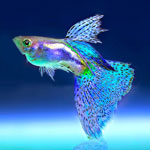
- The Trend: Liquid Metal Tails. Currently, many metallic guppies show iridescence on the body, but the caudal fin is merely pigmented. The future lies in strains where the Guanine crystals (Iridophores) spread throughout the entire fin structure, causing the tail to reflect light like polished silver or gold.
- The Goal: To produce a tail that changes color—from a pale blue to an intense emerald green—with the slightest movement or change in light angle. This ‘living chrome’ effect is achievable by line-breeding fish that exhibit the widest possible spread of the metallic genes, pushing the color field beyond the body and deep into the fin rays.
Prediction 3: Geometric Patterns – The Precision of the Digital Age
The most challenging area of breeding is pattern control. It is easy to breed a blotchy pattern, but extremely difficult to breed a pattern with straight lines and sharp, perfect angles. This precision is where the show circuit will move.
A. The Fragmented Mosaic and Pixelated Patterns
This is the evolution of the Snakeskin and Cobra patterns, moving from a naturally smooth, organic webbing to a sharp, intentionally broken pattern.
- The Trend: Angular Color Blocks. Future patterns will feature solid blocks of color separated by clean, defined seams, resembling modern digital camouflage or shattered glass. This requires complex genetic selection that allows for the pattern to be formed by small, defined squares or triangles of color, rather than smooth bands.
- The Breeder’s Test: This tests the breeder’s ability to selectively cull out fish where the pattern bleeds or rounds off. The more acute and precise the angle of the color boundary, the higher the value of the strain. This is a direct testament to the selective power applied by the breeder.
B. The Perfected Edge Markings (The Halo Fin)
Instead of focusing on the center of the fin, attention will turn to the borders, using them as high-contrast frames for the fish’s movement.
- The Trend: The ‘Halo’ or ‘Reverse Outline’ will feature a large, solid-colored tail (e.g., intense blue), framed by a thin, perfectly consistent, and highly visible band of a contrasting color (like neon yellow or opaque white) along the entire outer edge.
- Why it Matters: In movement, this thin, bright border provides an astonishing visual effect, creating a perceived size and flow that is greater than the fish’s actual dimensions. The key genetic battle here is controlling the gene that determines color termination at the fin margin, ensuring the line is perfectly uniform and does not thin or thicken.
The Catalysts: Why These Trends Are Happening Now
These complex trends are not random; they are driven by advances in technology and breeder practices that provide the necessary control.
1. The Power of Digital Phenotyping
In the past, breeders judged color by eye under ambient light. Today:
- Standardized Photography: Digital cameras and phone apps allow breeders to capture images under standardized lighting and backgrounds, eliminating subjective viewing.
- Software Analysis: Breeders can use basic image editing software to analyze color saturation levels and, critically, measure the thickness and straightness of pattern lines (like a Cobra bar or a Halo edge). This allows for a scientific, quantitative approach to culling and selection, accelerating genetic advancement exponentially.
2. Specialized Nutrition
Achieving the high saturation and textural depth described requires more than just good genetics; it requires the right building blocks.
- Astaxanthin Maximization: To achieve the “Velvet Red” and “Neon Spectrum” colors, breeders are moving away from simple flake foods and relying on highly concentrated, specialized diets rich in pure Astaxanthin, Beta-Carotene, and other high-carotenoid sources (often through dedicated frozen or live feeds like Daphnia and baby brine shrimp).
- Mineral Supplementation: To support the massive finnage and high iridescence, mineral supplements (like those that boost $\text{GH}$ and $\text{KH}$) are becoming a crucial component of the breeding regimen, ensuring that the fish have the calcium and magnesium needed for robust skeletal and scale development.
Conclusion: The New Standard of Excellence
The future of the guppy lies in the synthesis of beauty and technical mastery. It’s no longer enough for a guppy to be ‘nice and red’—it must be ‘Velvet Red’ with perfect finnage developed in pristine water. The trends toward Tri-Chroma Saturation, Velour Texture, and Geometric Precision will elevate the livebearer hobby to an even higher level of genetic art. Start breeding these traits now, and you will be at the forefront of the next great chapter in guppy history.