
Drip Acclimation for Guppies: Is it Overkill or Essential? (The Ammonia Risk Explained)
July 13, 2025 Guppy Fish
🚫 Drip Acclimation for Guppies: The Science That Proves It’s Overkill and Dangerous
Drip acclimation has long been regarded as the gold standard in the aquarium hobby for introducing new fish, particularly delicate species. However, for a hardy, highly adaptable fish like the Guppy (Poecilia reticulata), a traditional slow drip is not just overkill—it introduces a significant, life-threatening chemical risk.
For beginner and intermediate aquarists seeking the safest, most effective way to welcome their new guppies, the answer is counter-intuitive: A quick transition, often called “Plop and Drop” (after temperature matching), is scientifically safer.
I. 🔬 The Ammonia Trap: Why Slow Acclimation Poisons Hardy Fish
The danger of slow drip acclimation is rooted in basic water chemistry, specifically how $\text{pH}$ and ammonia interact in a sealed transport bag. Understanding this process is the key to minimizing mortality.
A. The Chemistry in the Sealed Bag
- $\text{CO}_2$ Build-up and $\text{pH}$ Drop: When a fish is sealed in a bag, it excretes waste and, more critically, exhales Carbon Dioxide ($\text{CO}_2$) through its gills. Because $\text{CO}_2$ cannot escape the sealed bag, it builds up and dissolves in the water, forming carbonic acid. This process causes the water’s $\text{pH}$ to drop, often significantly (e.g., from a neutral $\text{pH}$ of $7.5$ to an acidic $\text{pH}$ of $6.5$).
- Ammonia Detoxification: Fish also excrete Ammonia ($\text{NH}_3$), which is highly toxic. Fortunately, at the low $\text{pH}$ created by the $\text{CO}_2$ build-up, this toxic $\text{NH}_3$ is chemically converted into the relatively harmless Ammonium Ion ($\text{NH}_4^+$). The low $\text{pH}$ is the fish’s chemical lifeline during transit.
B. The Toxic Transformation Upon Opening
- The $\text{pH}$ Spike: The moment you open the bag to begin drip acclimation, the trapped $\text{CO}_2$ begins to rapidly escape, or “gas off,” into the air. This rapid loss of $\text{CO}_2$ causes the $\text{pH}$ of the bag water to rise just as quickly—a process known as a $\text{pH}$ spike.
- The Ammonia Conversion: As the $\text{pH}$ rises, the safe Ammonium ($\text{NH}_4^+$) instantly converts back into the highly toxic Ammonia ($\text{NH}_3$). The fish is now swimming in an increasingly concentrated bath of deadly poison.
- The Drip Paradox: By performing a slow, $30$-to-$60$-minute drip acclimation, you are deliberately prolonging the fish’s exposure to the now-toxic water. The fish’s gills become burned and damaged, leading to stress, disease, and often death days later, even after being placed in clean tank water.
II. 🐠 Guppy Hardiness: The Case Against Osmotic Shock
The traditional argument for drip acclimation is to prevent “osmotic shock,” which occurs when a fish’s osmoregulation (the process of balancing internal salt and water) fails due to a rapid change in Total Dissolved Solids ($\text{TDS}$) or hardness.
- Guppies are Livebearers: Guppies are members of the Poeciliidae family of livebearers. They naturally inhabit varied ecosystems, from freshwater rivers to brackish estuaries.
- Broad Tolerance: They are biologically designed to tolerate a remarkably wide range of water parameters, including salinity levels up to $150\%$ that of normal seawater.
- Conclusion on Guppies: For the typical difference in water hardness and $\text{pH}$ between a local fish store and a well-maintained home aquarium, a healthy guppy’s osmoregulatory system can quickly adjust without the need for a slow, $60$-minute drip. The risk of osmotic shock is minimal, while the risk of ammonia poisoning is immediate and high.
III. ✅ The Safest Protocol: Temperature Match and Quick Transfer
For guppies and most other commonly purchased, hardy freshwater fish (like Platies, Mollies, Danios, and Corydoras), the best method focuses on two crucial factors: temperature and speed.
Step-by-Step: The “Plop and Drop” Method
| Phase | Duration | Action | Rationale |
| 1. Temperature Acclimation | $15\text{–}20$ minutes | Float the sealed bag in your aquarium. | This is non-negotiable. Sudden temperature shifts are a major stressor for any fish. Keep the bag sealed to maintain the beneficial $\text{CO}_2$/low $\text{pH}$ state. |
| 2. Quick Transfer Prep | $30$ seconds | Prepare a clean fish net and a discard bucket. | Get ready for a rapid transition out of the bag water. |
| 3. The “Plop and Drop” | $10$ seconds | Open the bag, quickly net the fish, and gently place (or “plop”) them directly into the tank water. | This minimizes the fish’s exposure to the toxic ammonia created once the bag is opened. |
| 4. Final Action | Immediate | Discard the bag water. NEVER pour it into your aquarium. | Prevents introducing toxic ammonia, as well as any pathogens or parasites from the store’s system. |
IV. 🚨 When Drip Acclimation Is Actually Necessary
While it is overkill for guppies, the traditional drip method still holds value for a few specific aquatic creatures due to their extreme sensitivity:
| Category | Reason for Drip Acclimation |
| Invertebrates | Shrimp (Cherry, Amano, etc.) and Snails. These animals are acutely sensitive to minute shifts in $\text{pH}$ and $\text{TDS}$ (hardness). A slow drip is crucial to prevent fatal molting or shell shock. |
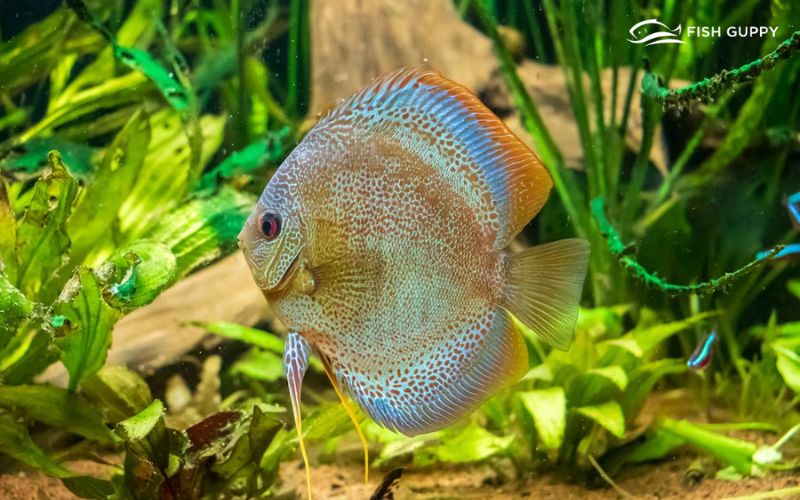
| Delicate Fish | Wild-Caught or Very Soft-Water Fish (e.g., Discus, some wild Tetras, Cardinal Tetras). These species have a much narrower tolerance range for water chemistry. |
| Shipped Fish | If fish were in transit for 24+ hours, the bag water may have an extreme concentration of accumulated waste. In this case, you must add an ammonia detoxifying product (like Seachem Prime) to the bag/acclimation container before dripping to neutralize the immediate threat. |