
The Complete Beginner’s Guide to Guppy Fish Care
September 29, 2025 Discus FishIntroduction: Why Guppies are the Perfect Starter Fish
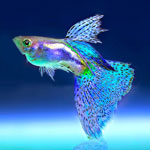
Stepping into the world of fish-keeping? Get ready to meet your first vibrant, wiggly, and endlessly fascinating companions: the guppy! Often called the “Rainbow Fish” due to the male’s dazzling, flowing tails and colors, guppies (Poecilia reticulata) are much more than just beautiful. They are hardy, active, and their ease of care makes them the absolute best choice for a beginner’s aquarium.
Forget the myth that fish are boring. A tank full of healthy guppies is a mesmerizing, lively spectacle! This ultimate beginner’s guide will cover everything you need to set up a happy home for your new, colorful friends.
🏠 The Ideal Guppy Home: Tank Setup & Environment
Getting the tank right is the single most important step for long-term guppy happiness.
- Tank Size: While some sources suggest a 5-gallon tank, we recommend starting with a 10-gallon aquarium minimum. Guppies are active and like to swim, plus a larger tank stays stable longer, making your job easier!
- The Right Ratio: Guppies are social (shoaling) fish, and you should keep them in groups. If you mix males and females, always aim for a ratio of 1 male to 2-3 females. Male guppies are persistent suitors, and having more females spreads out the attention, reducing stress.
- Water Temperature & Heater: Being tropical fish, guppies need warm water. An ideal temperature range is $74^{\circ}\text{F}$ to $82^{\circ}\text{F}$ ($23^{\circ}\text{C}$ to $28^{\circ}\text{C}$). You will need a reliable aquarium heater and a thermometer to keep the temperature stable.
- Filtration & Water Flow: Use a gentle filter, like a sponge filter or a low-flow hang-on-back filter. Guppies don’t like strong currents that push them around. Filtration is vital for keeping the water clean and clear.
- Decorations & Plants: Guppies thrive in a well-decorated tank. Live plants like Java Moss, Anubias, and Water Sprite are perfect—they not only look great but also help keep the water clean and provide essential hiding spots (especially for baby fry!). Rocks, driftwood, and small caves work well too.
💧 Water Wisdom: Keeping the Environment Pristine
Guppies are hardy, but they rely on you to keep their water quality excellent.
| Parameter | Ideal Range | Why it Matters |
| pH | $6.8 – 7.8$ (Slightly Alkaline) | Affects their overall health and stress levels. |
| Ammonia ($\text{NH}_3$) | $\mathbf{0}\text{ ppm}$ | Highly toxic. Produced by fish waste. |
| Nitrite ($\text{NO}_2$) | $\mathbf{0}\text{ ppm}$ | Highly toxic. The first stage of breaking down ammonia. |
| Nitrate ($\text{NO}_3$) | Below $\mathbf{40}\text{ ppm}$ | Less toxic, but builds up over time and requires water changes. |
| Routine Care | $25\%$ water change weekly | Essential for removing nitrates and replenishing minerals. Always use a water conditioner! |
Pro Tip: Never use plain tap water! Always add a dechlorinator/water conditioner to new water to remove harmful chlorine and chloramines.
🍽️ Feeding Time: The Guppy Diet
Guppies are omnivores and will eat almost anything, but a varied diet keeps them healthy and their colors bright.
- Staple Food: High-quality guppy flake food or micro-pellets should be the base of their diet. Look for options with high protein.
- Variety is Key: Supplement their flakes with occasional treats like frozen or freeze-dried bloodworms, brine shrimp, or daphnia. You can also offer a small amount of blanched zucchini or peas.
- How Much to Feed: Feed them small pinches 2-3 times per day, only giving them an amount they can completely finish in less than two minutes. Overfeeding is the number one mistake beginners make; it pollutes the water and can cause health issues.
🍼 The Joy of Fry: Understanding Guppy Breeding
Guppies are famous “livebearers,” meaning they give birth to fully formed, free-swimming babies (called fry). If you have males and females, breeding will happen!
- Protecting the Babies: Adult guppies will eat their own fry. To save them, you can move the pregnant female to a breeding box or, more naturally, provide a dense layer of floating plants like Guppy Grass or Hornwort for the fry to hide in.
- Fry Food: Feed the babies specially formulated fry food, crushed flakes, or baby brine shrimp several times a day for fast growth.